


Market Research

Analysis and trends impacting construction, housing and development markets.

  • March sees lowest saving rates since June 2022

    March sees lowest saving rates since June 2022

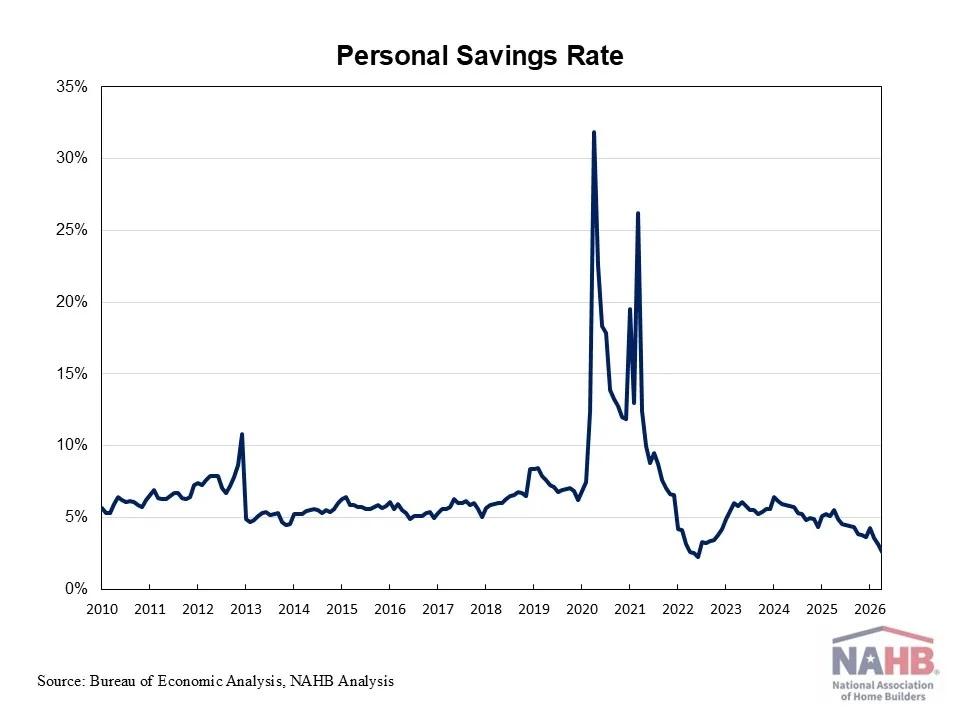
    According to the latest data from the Bureau of Economic Analysis, March 2026 saw the lowest personal saving rates since June 2022. On a year-over-year basis, personal income was 2.5% higher in March than in April 2025. As consumer spending outpaced income growth, the personal saving rate fell to 2.6%. This data point implies households are drawing more heavily on savings to support spending.

    Personal income was essentially unchanged in April 2026, following a 0.5% gain in March. Personal consumption expenditure rose 0.5% in April, following a 1% increase in March. Real spending, which was adjusted to remove inflation, increased 0.1% in April, with expenditure goods declining 0.2% and spending on services up 0.2%.

    Read More

  • Construction sees life in custom homebuilding

    Construction sees life in custom homebuilding

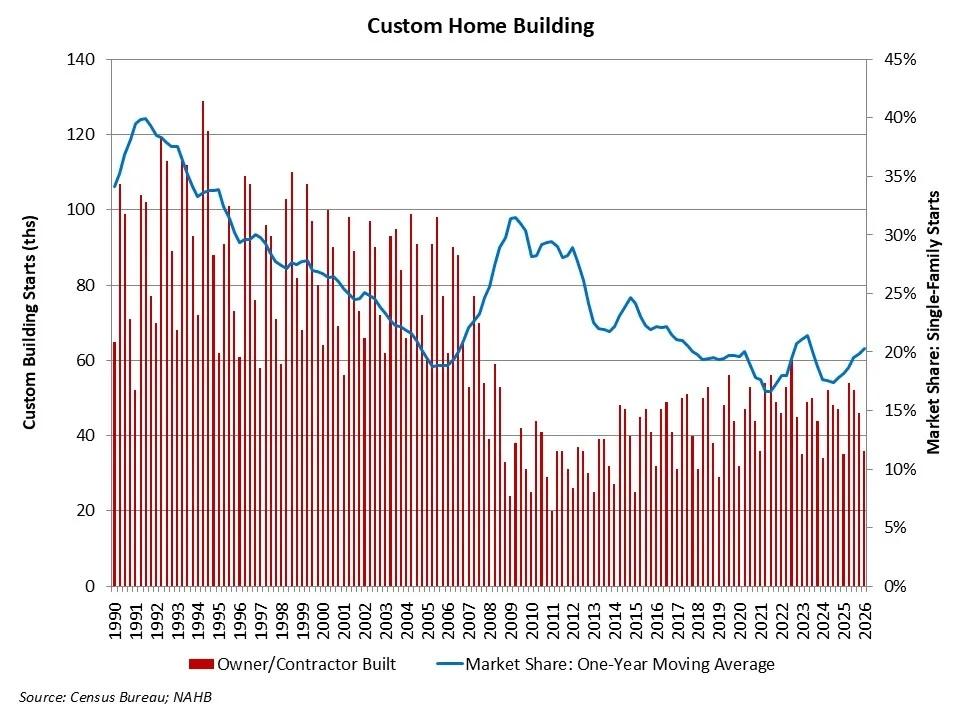
    The custom home market is not as heavily impacted by the interest rate cycle in comparison to other forms of homebuilding, making it a relative bright spot in residential construction. While overall single-family construction has been down 5% for the first four months of 2026, custom homebuilding is providing relief in the homebuilding.

    According to the National Association of Home Builders’ (NAHB) analysis of Census data from the Quarterly Starts and Completions by Purpose and Design survey, there were 36,000 total custom building starts during the first quarter of 2026. This is up 3% relative to the first quarter of 2025.

    Currently, the market share of custom builds, based on a one-year moving average, is 20% of total single-family starts.

    Read More

  • 10 cities lead new home construction

    10 cities lead new home construction

    Consumer Affairs analyzed data on new building permits and new-construction home sales across the 150 largest U.S. metros in early 2026.  The data ranked areas based on both the number of new-build permits issued and the number of new homes sold, with each factor weighted equally. Based on the analysis, 10 cities are leading the charge in new home construction, with thousands of new housing permits issued and more than 15,000 newly constructed homes sold.

    Four of the top cities in new home construction were in Texas, with Dallas holding the leading spot. The city had 11,327 new building permits issued and over 3,000 new construction homes sold.

    Houston follows closely behind in second place, followed by New York, Phoenix, Atlanta and Los Angeles, respectively. Austin, Texas, ranked No. 7, followed by Washington, D.C., Charlotte, N.C. and San Antonio.

    Read More


  • Pending home sales pick up in March

    Pending home sales pick up in March

    Pending home sales picked up 1.5% in March 2026 despite mortgage rates varying throughout the month, suggesting that rising borrowing costs may have pushed homebuyers to act while the housing market conditions showed signs of improvement. While contract signings were down 1.1% year-over-year, the monthly gain points to underlying demand going into the spring buying season. Rates rose from around 6.11% in mid-March to 6.38% by month’s end.

    The Realtor.com® March 2026 Housing Trends Report showed pending listings increased 3.9% year-over-year, the third consecutive month of annual gains, while new listings surged 21.2% from February to 439,000, exceeding the typical seasonal jump and giving buyers the most fresh inventory to browse in several years.

    Read More

  • Single-family housing starts surge in March

    Single-family housing starts surge in March

    U.S. single-family homebuilding increased to a 13-month high in March. According to the Commerce Department’s Census Bureau, single-family housing starts, which account for ​the bulk of homebuilding, surged 9.7% to a seasonally adjusted annual rate of ‌1.032 million units, the highest level since February 2025.

    Single-family housing starts increased to a pace of 941,000 units in February from 898,000 units in January. They rose 8.9% year-on-year in March. Overall housing starts vaulted 10.8% to a pace of 1.502 million units and increased 10.8% year-on-year in March.

    Read More

  • NAR releases new homebuyer market data

    NAR releases new homebuyer market data

    According to newly released data from the National Association of Realtors (NAR), adults ages 61 to 79, otherwise known as the baby boomers, accounted for 42% of all homebuyers and 55% of all sellers over the past year. This generation overtook millennials in 2025 and maintains a firm grip on the housing market, relying on housing wealth accrued over decades to bypass the high prices, which challenge younger, potential homebuyers.

    “The housing market remains sharply divided between homeowners with equity and first-time buyers trying to break in,” said Jessica Lautz, NAR’s deputy chief economist, in the report.

    As a result of these market dynamics, the share of first-time buyers among all homebuyers decreased to 21% over the last year, the lowest level since NAR began tracking the metric in 1981. Millennials, ages 27 to 45, who historically make up the bulk of first-time buyers, saw their overall buyer share drop from 29% to 26%.

    Read More 

  • More interest in construction trades among young adults

    More interest in construction trades among young adults

    A new survey from the National Association of Homebuilders (NAHB) reported a positive attitude amongst young adults, ages 18 to 25, towards the construction trades. In a positive development for the home building industry, the share interested in a career in the construction trades doubled from 3% in 2016 to 6% in 2026.

    Closing the housing deficit will necessarily entail recruiting younger workers willing to start a career in the construction trades. While most young adults know the field in which they want, or currently have, a career, certainty about career choice is waning. In 2016, 74% knew the field they wanted to work in. In 2026, that share is down to 65%. The drop is likely associated with broader economic uncertainty and changing labor market dynamics. However, NAHB’s survey revealed an improved interest in careers in residential construction.

    Read More 

  • Housing Affordability Reaches Best Level Since January 2022
    ,

    Housing Affordability Reaches Best Level Since January 2022

    Housing affordability began the year on its strongest footing since August 2022. In January 2026, the First American Data & Analytics Real House Price Index (RHPI) showed housing affordability improved nearly 11% compared with 2025. The improvement in affordability reflects a favorable combination of factors: Mortgage rates were 0.9 percentage points lower than a year ago, nominal house price growth nationally slowed to 0.6% and household income increased by 3.1%.

    While affordability remains more than 60& below its pre-pandemic five-year average, the recent progress offers a meaningful reprieve for prospective homebuyers. However, the strength of affordability gains varies across markets. For example, Cape Coral, Fla., stands out as the most improved among the top 100 markets, with affordability up more than 17% year-over-year.

    Read More

  • An Overview of the Homeowner Market
    ,

    An Overview of the Homeowner Market

    A Redfin analysis of U.S. Census data from 2024, the most recent year for which data is available, broke down the share of three-bedroom-plus homes owned and occupied by each generation, by household type and size. According to the analysis, baby boomers living in one- to two-adult households own 28% of large homes in the U.S. By comparison, millennials with children living at home own 16% of those houses, barely more than half as much. Generation Z parents own less than 1% of the nation’s large homes.

    Millennials are the largest generation of parents in the U.S., and are also the largest generation in the nation, yet they own a relatively small share of family-sized housing. This dynamic can limit mobility for younger families, many of whom face both inventory and affordability challenges when trying to upgrade to bigger homes.

    “Younger buyers are looking to move into single-family homes in specific neighborhoods, those with a family-friendly vibe and highly rated schools,” said Brenda Beiser, a Redfin Premier agent in Philadelphia. “The problem is, younger families have a hard time finding those homes because the older people living in them can’t find anywhere they want to move to.”

    Read More


  • An Overview of the Homeowner Market
    ,

    An Overview of the Homeowner Market

    A Redfin analysis of U.S. Census data from 2024, the most recent year for which data is available, broke down the share of three-bedroom-plus homes owned and occupied by each generation, by household type and size. According to the analysis, baby boomers living in one- to two-adult households own 28% of large homes in the U.S. By comparison, millennials with children living at home own 16% of those houses, barely more than half as much. Generation Z parents own less than 1% of the nation’s large homes.

    Millennials are the largest generation of parents in the U.S., and are also the largest generation in the nation, yet they own a relatively small share of family-sized housing. This dynamic can limit mobility for younger families, many of whom face both inventory and affordability challenges when trying to upgrade to bigger homes.

    “Younger buyers are looking to move into single-family homes in specific neighborhoods, those with a family-friendly vibe and highly rated schools,” said Brenda Beiser, a Redfin Premier agent in Philadelphia. “The problem is, younger families have a hard time finding those homes because the older people living in them can’t find anywhere they want to move to.”
    Read More

  • Single Women Outnumber Single Men in Homeownership

    Single Women Outnumber Single Men in Homeownership

    According to new research from the National Association of Realtors, over 20 million single women own homes, significantly outnumbering the roughly 14 million single men who do. Representing 21% of all buyers, women are becoming a driving force in the buyer’s market. Over the last 10 years, homeownership has grown among divorced, separated and never-married women.

    “Over the past two decades, homeownership among single men has been relatively flat, while single women have consistently maintained higher homeownership rates—and you see that showing up in today’s market,” said NAR senior economist Nadia Evangelou.

    Read More

  • Consumer Confidence Climbs in March

    Consumer Confidence Climbs in March

    Consumer confidence in March rose to a three-month high as consumers’ improved view of current business and labor market conditions outweighed weaker future expectations. Despite the increase, consumers remained concerned as inflation expectations surged to a seven-month high due to the Iran war and job worries from economic uncertainty.

    The Consumer Confidence Index, reported by the Conference Board, is a survey measuring how optimistic or pessimistic consumers feel about their financial situation. This index rose from 91.0 to 91.8 in March, the highest level this year.

    The Conference Board also reported the share of respondents planning to buy a home within six months. The share of respondents planning to buy a home fell slightly to 5.7% in March. Of those, the shares planning to buy a newly constructed home and an existing home were unchanged at 0.7% and 2.6%, respectively. The remaining 2.4% were planning to buy a home but were undecided between new or existing homes.

    Read More

  • Builders respond to market with innovative design

    Builders respond to market with innovative design

    According to the U.S. Census Bureau and the National Association of Realtors’ data, newly built homes are typically priced at or below existing homes, offering buyers more options in today’s challenging housing market. The homebuilding industry is responding to market conditions by constructing homes that balance price and meet modern homebuyer needs.

    Builders are increasingly expanding usable living space with patios, front porches and decks, complemented by exterior lighting and landscaping. Builders are also adapting to buyers’ preferences for flexible interiors and modern features, such as adding drop zones, adding a charging station for EVs and including multipurpose rooms in homes.

    “Homeownership remains a cherished ideal for families across the country, and builders are stepping up to make homes attainable,” said NAHB Chairman Bill Owens, a home builder and remodeler from Worthington, Ohio. “We will continue working with policymakers at every level of government to address supply-side challenges and seek regulatory relief that affects housing affordability.”

    Read More

  • Most homebuying Americans are not discouraged by Iran conflict

    Most homebuying Americans are not discouraged by Iran conflict

    In a recent survey from Redfin, 56% of respondents indicated the Iran war has no impact on their plans to make a major purchase. Economists say that this conflict has similar minimal repercussions on major purchasing activity as the federal government shutdown in October.

    In their report, even in areas with a concentrated military conversation, concerns of the Iran conflict rarely comes up between agents and buyers. Despite concerns of rising oil prices and mortgage rates, more Americans are concerned about continuing headwinds of tariffs and the job market. In total only 7% are cancelling plans to make a major purchase (which includes both houses and cars), while 18% of respondents are delaying the decision.

    “But as of the first week of March, most Americans were undeterred in plans to buy something costly like a home or car,” said Dana Anderson at Redfin.

    Read More 

  • Research shows architects seek building innovation influence

    Research shows architects seek building innovation influence

    On Feb. 25, 2026, the American Institute of Architects (AIA), in collaboration with Deltek and ConstructConnect, published the latest Architect’s Journey to Specification report, exploring how architects make specification decisions and collaborate with building product manufacturers. 

    Innovation & Collaboration in the Architect’s Journey to Specification, provides comprehensive analysis of three key areas; how architects engage with manufacturers, adopt innovative technologies and integrate sustainability into their design processes. 

    “By understanding these trends, the profession can strengthen collaboration, accelerate innovation, and advance sustainable practices that benefit clients and communities,” said AIA EVP/Chief Executive Officer Carole Wedge, FAIA. 

    Read More


  • Michigan homebuilding reports increased activity in 2025

    Michigan homebuilding reports increased activity in 2025

    A recent release from the Home Builders Association of Michigan (HBAM) announced that last year’s single-family home production grew by 4.7% in 2025. This was gauged by permit activity and exhibits that a total of 15,821 single-family  permits were issued. This is a welcome increase compared to 15,108 in 2024.

    This report also comes as the end of year data from the federal government is delayed due to the shutdown in the fall. The estimated average market value HBAM reported for new single-family homes built last year in the state was $475,024. This is a 6.5% increase in Michigan in 2025.

    ““The state housing authority has done a tremendous job in trying to expand these efforts, but more needs to be done,” said Bob Filka, CEO of the HBA of Michigan. “Streamlining regulatory processes and expanding the use of innovative financial mechanisms to support the production of more attainable housing in our state is critically important.” 

    Read More 

  • New home sales rose in September and October
    ,

    New home sales rose in September and October

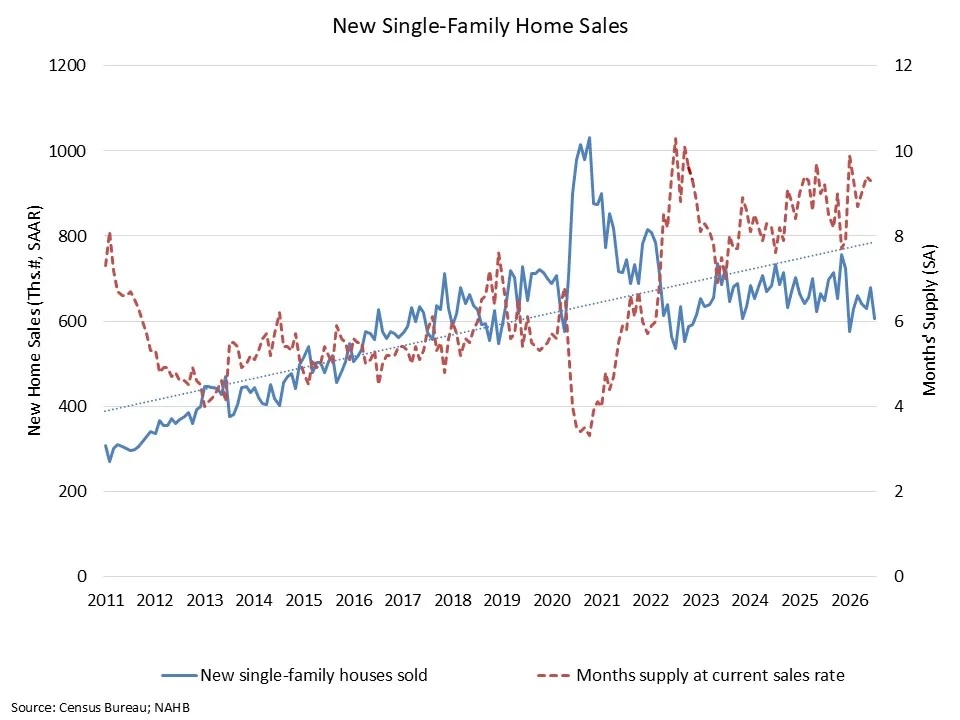
    The U.S. Census Bureau released the delayed Monthly New Residential Sales report for both September and October 2025.The September data reports a seasonally-adjusted annual rate of 738,000 and an October a rate of 737,000. Despite not much month to month change there is a significant 18.7% year over year increase.

    This data suggests a brighter future for the 2026 outlook. The period of September-October 2025 is now the strongest two-month stretch for new-home sales since early 2022.

    While the median sales price of new homes was 405,800 and $392,300 in September and October respectively. This is a eight percent decrease from the October 2024 price of $426,300. Yet this decrease is not surprising with many builders offering incentives and mortgage rate buydowns alongside lower prices.

    The release of the November data is still to be determined by the U.S. Census Bureau.

    Read More 

  • The top master-planned communities of 2025

    The top master-planned communities of 2025

    John Burns Research and Consulting (JBRC) announced their annual top 50 master-planned communities (MPCs) for 2025. In their 15-year survey history, this year’s sales threshold is the sixth-highest performing. 2025 boasted stable sales in highly developed master-planned communities. Topping the overall list is The Villages, The Villages, FL with 3,611 sales in 2025 and a 13% year-over-year growth. Following in the top five are Lakewood Ranch, Cadence, Babcock Ranch and Sunterra. Additionally, the Asante master plan in Phoenix achieved the highest year-over-year sales growth, up 192% from 2024.

    Leading sales factors of MPCs encapsulate the overall lifestyle planning. Factors like high-quality amenities, access to strong schools, enhanced security and/or controlled access, mixed product offerings appealing to multiple life stages and built-in sense of community and belonging remain large factors in their success.

    “Despite elevated inventory, which affected even top-performing MPCs, communities that combined targeted incentive strategies, compelling lifestyle positioning and well-coordinated sales execution outperformed.” said the team at JBRC.

    Photo Credit: Sunterra Starwood Land featured in the December issue of Builder and Developer.

    Read More 

  • 2025 ended with the lowest mortgage rates of the year
    ,

    2025 ended with the lowest mortgage rates of the year

    Long-term mortgage rates are currently at their lowest level since September 2024. With incremental declines and three rate cuts from the Fed throughout the year, the 30-year fixed-rate mortgage average reported as 6.19% in December. Analysis from Freddie Mac shows that the 30-year fixed-rate mortgage is 5 basis points (bps) lower than November. This makes the 30-year rate lower by about half a percentage point compared to a year ago. Looking at the 15-year rate of 5.48% saw a 3 bps decrease. This is 45 bps lower than it was a year ago.

    “An NAHB analysis shows that a 25 bps reduction in the 30-year mortgage rate, from 6.25% to 6.00%, could bring approximately 1.1 million additional households back into the buyer pool,” wrote NAHB Forecasting and Analysis economist Catherine Koh. “NAHB expects the 30-year mortgage rate to average 6.17% in 2026 and would reach 6% by 2027.”

    Read More

  • Homeownership rate inches up
    ,

    Homeownership rate inches up

    According to the Census’s Housing Vacancy Survey (HVS) of Q3 2025, the latest homeownership rate rose up to 65.3%. However this rate is not an anomaly from the third quarter 2024  rate (65.6 percent) nor the rate in the second quarter 2025 (65.0 percent).

    While this is a step in the right direction, there are still some signs that affordability issues persist. The homeowner vacancy rate of 1.2 percent was higher than the rate in the third quarter 2024 (1.0 percent) and higher than the rate in the second quarter 2025 (1.1 percent). Additionally, in the third quarter 2025, the median asking rent for vacant for rent units was $1,534. This rate of 65.3% is still significantly below the peak of 69.2% in 2004. Currently, it remains below the 25-year average rate of 66.3%.

    Compared to the previous year, homeownership rates increased in three age groups while decreasing in two. Homeownership for those under 35 saw a .5% uptick to 37.5%. This age group is particularly sensitive to the renting and entry level-market. With inventory and affordability concerns persisting throughout 2025, while not a sign of a complete market turnaround it exhibits some success. The 45-54 age range saw less of an increase at .3% but puts them at a strong 70%.  Homeownership rates for the ranges 35-44 and 65 years and over each declined 1.2 percentage points from a year ago.

    “The housing stock-based HVS revealed that the number of total households increased to 133.1 million in the third quarter of 2025 from 132.0 million a year ago,” said Na Zhao, Ph.D., Principal Economist at NAHB. “This increase was driven by both owner and renter household growth.”

    The fourth quarter 2025 data from the Census is scheduled for release on February 3, 2026.

    Read More 

  • Starter-home sales rise

    Starter-home sales rise

    In October, starter-home sales posted a significant 4.9% year over year increase. This is the 14th consecutive month of increase, showing the market is allowing for new-buyers to get their foot in the door. The increase is also a major jump in comparison to other parts of the market, sales of mid-priced homes inched up 0.7% and high-priced home sales rose 0.8%. However the increase in sales is not contributing to a price increase. According to a Redfin analysis,  starter home prices only rose an estimated 2% year over year. The average price in October was $260,000. Notably this is the second slowest growth in the past decade.

    The minimal rise in price is likely due to an increased supply. Currently, inventory is at its highest October level since 2016. Major metro areas saw a large increase in starter homes sold year-over-year, this includes San Francisco (19.5%), Providence (6.3%) and Portland (12.9%).

    “The starter-home market is a double-edged sword right now. Conditions are improving, with more listings and steadier prices, but many buyers are only turning to this tier because they have been priced out of higher tiers,” said Redfin Head of Economic Research Chen Zhao. “That means sales at the low end of the market are relatively strong, but it also means that first-time buyers may find themselves competing with move-up or move-down buyers.”

    Read More 

Sorry, but nothing was found. Please try a search with different keywords.


Sorry, but nothing was found. Please try a search with different keywords.