News

  • 21st Century ROAD to Housing Act advances to Senate

    21st Century ROAD to Housing Act advances to Senate

    The 21st Century ROAD to Housing Act has reached the Senate. The bill aims to solve the national affordable housing shortage by increasing supply, easing regulatory burdens and modernizing outdated U.S. Department of Housing and Urban Development programs.

    On May 22, 2026, the U.S. House of Representatives approved an amendment to the bill that would have removed a build-to-rent sales provision that would have hurt affordability and reduced much-needed housing supply. The National Association of Home Builders (NAHB) led the push to remove the provision and has been an active supporter of the bill.

    “NAHB congratulates congressional leaders for reaching a bicameral and bipartisan agreement to move forward a final version of the 21st Century Road to Housing Act,” said Bill Owens, NAHB chairman, a home builder and remodeler from Worthington, Ohio. “This landmark legislation would expand housing opportunities for buyers and renters, strengthen homeownership and help tackle the affordability challenges facing communities nationwide. It’s time for Congress to move this historic housing package across the finish line.”
    Read Full Article

  • NAHB study analyzes homebuilding regulatory costs

    NAHB study analyzes homebuilding regulatory costs

    A new study from the National Association of Home Builders (NAHB) analyzed homebuilding regulatory costs, comparing results from the 2026 survey to a previous one conducted in 2021. The 2026 survey revealed that, on average, regulations imposed by the government at all levels account for $131,734, or 26.4%, of the final price of a new single-family home built for sale. Of this amount, $46,795 is due to a higher price for the finished lot, a direct result of regulations imposed during the lot’s development. The remaining $84,939 is the result of regulatory costs imposed on the builder during construction, after the builder purchases the finished lot.

    According to the study, regulatory costs are one of several factors, including record increases of tariff rates on building materials, ongoing skilled labor shortage, a decrease in available lots and tighter lending conditions, currently limiting the supply of housing, particularly housing for the entry-level market.

    Read Full Article

  • Lennar announces C-suite changes

    Lennar announces C-suite changes

    Lennar, one of the nation’s largest homebuilders, announced two appointments in its C-suite: Jim Parker named Chief Operating Officer and David Grove appointed to Executive Vice President, Homebuilding.

    Parker joined the company in 2018 following its merger with CalAtlantic Homes. Following the merger, he served as a Regional President for the builder. In 2003, Parker founded Parker Chandler Homes and sold the company three years later.

    Grove joined Lennar in 1999 as a Construction Area Manager in Austin. He was then named Division President in 2004 and Regional President for Texas in 2022.

    “Jim and David are tenured, proven Lennar leaders who are energized by the opportunity ahead,” said Stuart Miller, Lennar’s Executive Chairman, Chief Executive Officer and President. “They have consistently delivered strong results for our teams and our business. More than that, they exemplify our core values — building quality homes and delivering more value to our customers, always with the highest level of integrity.”

    Read Full Article

  • Takeaways from the current housing economy

    Takeaways from the current housing economy

    The Harvard Joint Center for Housing Studies released its annual State of the Nation’s Housing report, offering an overview of the current housing market. Many indicators show that housing market activity remained flat in early 2026. New home sales levels remained relatively unchanged, rental retention rates increased and new occupancies declined. Construction saw a slight decrease of 1% over the past year. Key takeaways from the report include subdued activity, weakening demand, and sidelined potential homebuyers.

    The current weakness in housing demand is a direct result of several underlying economic drivers and a decreasing employment growth rate.

    With many U.S. residents burdened by high housing costs, an increasing number of state and local governments are taking action to increase housing production.

    Read Full Article

  • May 2026 Luxury Housing Market Report

    May 2026 Luxury Housing Market Report

    Luxury home prices across the U.S. reached $1,283,432 in May 2026, despite year-over-year declines continuing at -1.4%. The pace of annual softening has pulled back considerably from the 5%-plus drops seen in early 2025, suggesting an uptick in the national luxury housing market.

    Among tracked luxury metros, Minneapolis and Boise City, Idaho, have fully surpassed their pandemic-era peaks as of February, at 5% and 4.2%, respectively. The composition of the top 10 luxury markets was unchanged from April, with the same 10 appearing in slightly different order.

    Year over year, Naples-Marco Island, Fla., at 4.3%, and Crestview-Fort Walton Beach-Destin, Fla., at 3.2%, were the only markets on the list with positive annual price growth.

    Read Full Article

  • June 2026 Housing Market Forecast

    June 2026 Housing Market Forecast

    The National Association of REALTORS released an analysis forecasting the housing market dynamics in June, including sales, inventory and buying trends. The analysis cited various factors, called seasonality trends, that influence the housing market and compared the current market conditions to previous seasonality trends to predict the June 2026 housing forecast.

    The analysis found that existing-home sales typically rise by 8.2% during the month, reaching their highest level of the year on average. The beginning of the summer marks a distinct shift in the housing market, characterized by the end of the school year for most localities, additional daylight and consistently warm weather. These conditions provide more flexibility for potential buyers to view a wider range of open listings.

    June usually sees an average increase of 0.8% in housing inventory, presenting specific advantages for sellers, including the optimal moving conditions previously mentioned, if they plan to buy and the high prices associated with the season.

    Historically, the average home spends about 30 days on the market in June, representing the fastest turnover in the year, alongside May. The favorable weather conditions drive prospective buyers to spend more time viewing homes, resulting in more frequent offers and decreasing the days spent on the market.

    Read Full Article

  • Fed holds rates steady in Warsh’s first decision as chairman

    Fed holds rates steady in Warsh’s first decision as chairman

    Kevin Warsh’s first decision as chairman of the Federal Reserve kept interest rates steady. The Fed’s rate holding pattern is consistent throughout 2026; the last rate cut was in December 2025.

    Warsh and the board affirmed that despite geopolitical uncertainty and a rise in inflation, the U.S. economy holds strong, with the unemployment rate largely unchanged and consumer spending up 0.09% in May.

    For housing and construction, employment is up year over year and a major housing bill is set to move towards signing.

    “Despite ongoing pressure on the Fed to ease ahead of the midterms, inflation remains the primary driver of policy decisions,” said Dr. Selma Hepp, Chief Economist for Cotality and regular contributor to Builder & Developer. “While we expect administrative focus to zero in on housing affordability again—likely through increased incentives as sales continue to disappoint—elevated costs and borrowing rates will persist. Importantly, regardless of Fed action, mortgage rates are unlikely to fall meaningfully until inflation cools and long-term yields move decisively lower.”

    “Overall, the June meeting pivoted the Fed to a notably more hawkish bias, reflecting an increase in current inflationary challenges,” said the National Association of Home Builders Chief Economist Robert Dietz. “Without relief from underlying causes of inflation, Fed policy action will not aid the housing and building market in the near term. However, there are dovish or disinflationary possibilities in the outlook, from resolution of geopolitical headline risks or benefits from productivity growth.”

    Read Full Article 

  • Industry legends honored with National Housing Center Awards

    Industry legends honored with National Housing Center Awards

    Several industry leaders were honored for their contributions to the housing industry during the National Housing Center Awards Ceremony on June 13, 2026, in Washington, D.C. The ceremony recognized the 2026 inductees to the National Housing Hall of Fame and the recipients of the Exemplary Service to Home Building Award.

    Thomas Bozzuto and Laurie Goodman were among the National Housing Hall of Fame inductees. Bozzuto redefined the standards for building and managing homes, provided thought leadership on housing policy and has been an advocate for sustainable development. Goodman, who founded the Housing Finance Policy Center at the Urban Institute, spent more than 30 years primarily focused on mortgage market research and analysis.

    The 2026 Exemplary Service to Home Building Award recipients were Marvin “Jerry” Carter Jr. and Edward “Eddie” Martin Jr.

    Read Full Article

  • 21st Century ROAD to Housing Act advances to Senate

    21st Century ROAD to Housing Act advances to Senate

    The 21st Century ROAD to Housing Act has reached the Senate. The bill aims to solve the national affordable housing shortage by increasing supply, easing regulatory burdens and modernizing outdated U.S. Department of Housing and Urban Development programs.

    On May 22, 2026, the U.S. House of Representatives approved an amendment to the bill that would have removed a build-to-rent sales provision that would have hurt affordability and reduced much-needed housing supply. The National Association of Home Builders (NAHB) led the push to remove the provision and has been an active supporter of the bill.

    “NAHB congratulates congressional leaders for reaching a bicameral and bipartisan agreement to move forward a final version of the 21st Century Road to Housing Act,” said Bill Owens, NAHB chairman, a home builder and remodeler from Worthington, Ohio. “This landmark legislation would expand housing opportunities for buyers and renters, strengthen homeownership and help tackle the affordability challenges facing communities nationwide. It’s time for Congress to move this historic housing package across the finish line.”

    Read Full Article

  • Mortgage rates average 6.52%

    Mortgage rates average 6.52%

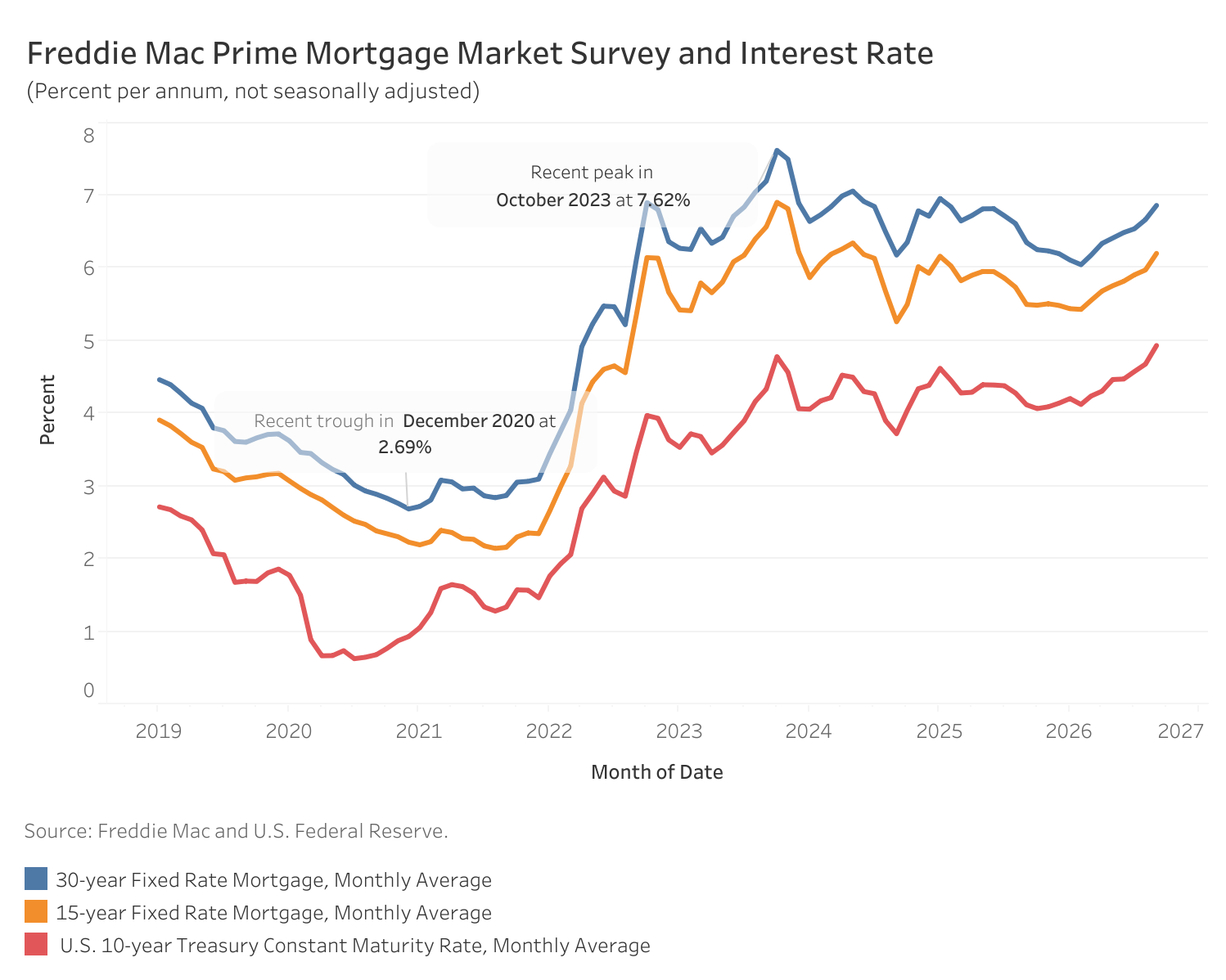
    On June 11, 2026, Freddie Mac released the results of its Primary Mortgage Market Survey, showing the 30-year fixed-rate mortgage reached an average of 6.52%.

    “The 30-year fixed-rate mortgage averaged 6.52% this week,” said Sam Khater, Freddie Mac’s Chief Economist. “Stronger employment momentum has helped existing home sales reach a five-month high. Importantly, we’re seeing homebuyers look past the short-term rate fluctuations and actively enter the market, signaling renewed confidence in homeownership opportunities.”

    The most recent 30-year FRM reached a 6.52% average, up from last week’s 6.48%. A year ago at this time, the 30-year FRM averaged 6.84%. Meanwhile, the 15-year FRM averaged 5.84%, up from last week’s average of 5.79%. A year ago at this time, the 15-year FRM averaged 5.97%.

    Read Full Article

  • NAHB study analyzes homebuilding regulatory costs

    NAHB study analyzes homebuilding regulatory costs

    A new study from the National Association of Home Builders (NAHB) analyzed homebuilding regulatory costs, comparing results from the 2026 survey to a previous one conducted in 2021. The 2026 survey revealed that, on average, regulations imposed by the government at all levels account for $131,734, or 26.4%, of the final price of a new single-family home built for sale. Of this amount, $46,795 is due to a higher price for the finished lot, a direct result of regulations imposed during the lot’s development. The remaining $84,939 is the result of regulatory costs imposed on the builder during construction, after the builder purchases the finished lot.

    According to the study, regulatory costs are one of several factors, including record increases of tariff rates on building materials, ongoing skilled labor shortage, a decrease in available lots and tighter lending conditions, currently limiting the supply of housing, particularly housing for the entry-level market.

    Read Full Article

  • Mortgage rates decrease to 6.48%

    Mortgage rates decrease to 6.48%

    On June 4, 2026, Freddie Mac announced that the 30-year fixed-rate mortgage (FRM) averaged 6.48%, according to its Primary Mortgage Market Survey. The FRM decreased from the week before, when it averaged 6.53%. A year ago at this time, the 30-year FRM averaged 6.85%.

    “The 30-year fixed-rate mortgage decreased to 6.48% this week,” said Sam Khater, Freddie Mac’s Chief Economist. “With mortgage rates in the mid-6% range and income growth outpacing home price growth, housing affordability is marginally improving.”

    The 15-year FRM averaged 5.79%, down from the week prior when it averaged 5.87%. A year ago at this time, the 15-year FRM averaged 5.99%.

    Read Full Article


  • June 2026 Housing Market Forecast

    June 2026 Housing Market Forecast

    The National Association of REALTORS released an analysis forecasting the housing market dynamics in June, including sales, inventory and buying trends. The analysis cited various factors, called seasonality trends, that influence the housing market and compared the current market conditions to previous seasonality trends to predict the June 2026 housing forecast.

    The analysis found that existing-home sales typically rise by 8.2% during the month, reaching their highest level of the year on average. The beginning of the summer marks a distinct shift in the housing market, characterized by the end of the school year for most localities, additional daylight and consistently warm weather. These conditions provide more flexibility for potential buyers to view a wider range of open listings.

    June usually sees an average increase of 0.8% in housing inventory, presenting specific advantages for sellers, including the optimal moving conditions previously mentioned, if they plan to buy and the high prices associated with the season.

    Historically, the average home spends about 30 days on the market in June, representing the fastest turnover in the year, alongside May. The favorable weather conditions drive prospective buyers to spend more time viewing homes, resulting in more frequent offers and decreasing the days spent on the market.

    Read Full Article

  • Residential Contractor Magazine: Coming July 2026
    ,

    Residential Contractor Magazine: Coming July 2026

    Residential Contractor Magazine

    THE PROJECTS. THE PRODUCTS. THE PROS.

    Residential Contractor connects manufacturers with the remodelers, contractors, trades and dealers shaping today’s residential construction market.

    The Summer 2026 issue features the National Deck Competition Winner’s Showcase alongside the products, tools, technology and business solutions driving better, more profitable projects.

    If you are interested in participating please contact fiona@builder.media 

  • Less young adults are first-time homebuyers

    Less young adults are first-time homebuyers

    According to a report from First American, young adults are the missing gap in first-time homebuyers. Nearly half of 20-to 24-year-olds still lived with their parents in 2025. Only about 25% of 25-to 29-year-olds owned their homes.

    The reality is that homeownership is arriving later in life for young adults, with the delay often originating at moving out of their childhood homes.

    Young adults are moving through traditional markers of adulthood, such as moving out, work, marriage and children, on a different timeline than previous generations. As those milestones shift, the housing sequence that often follows,  moving out, renting and buying, also shifts.

    Most young adults are still renting. While today’s renters are likely to become tomorrow’s buyer, that “tomorrow” is happening later in life. The reasons for this vary between affordability challenges, as well as other life milestones that have shifted into the later years, such as school, work or family.

    Read Full Article

  • Taylor Morrison acquired in $8.5 billion deal

    Taylor Morrison acquired in $8.5 billion deal

    Announced on May 31, 2026, Berkshire Hathaway will acquire homebuilding giant, Taylor Morrison for $8.5 billion. The all-cash transaction values Taylor Morrison at $72.50 per common share.

    This is the first major move from Berkshire Hathaway ‘s new CEO Greg Abel who assumed the role in January. Berkshire Hathaway owns Clayton Homes, the modern manufactured homebuilder, which it acquired in 2003 for $1.7 billion.. 

    There are indications of a consolidation between the two homebuilders. Between Taylor Morrison’s 12,997 closings and Clayton Properties’ 9,953 closings in 2025 would create the fourth largest homebuilder in the United States.

    “We are excited to welcome Taylor Morrison into Berkshire’s portfolio, reflecting our long-standing commitment to housing, exemplified by Clayton Homes and our other building products businesses,” said Abel. “Over time, we expect to unify our site-built homebuilding operations into a combined platform enabling us to deliver the dream of homeownership to more Americans.”

    However, Taylor Morrison’s extremely successful CEO Sheryl Palmer is not going anywhere following this acquisition. Berkshire Hathaway announced the Taylor Morrison team to continue with its existing management, including Palmer. Palmer drove the company to its nationwide strength and growth, going public in 2013 and currently building in 21 markets across 12 states.  Under her tenure, Taylor Morrison’s leadership team boasts a unique point of view, 50% of senior leadership roles are occupied by women, four times the industry standard.

    “Over the last 13 years as a public company, we built a track record of strategic growth—expanding our geographic footprint, integrating acquisitions with discipline and deepening our competitive strengths across procurement, brand and customer experience,” said Palmer. “Berkshire Hathaway’s long-term orientation is uniquely well-suited to the multi-year investment cycle of homebuilding, and this combination will allow us to scale the Taylor Morrison platform in ways that would not be possible as a standalone company.

    Read Full Article 

  • Mortgage rates average 6.41% in May

    Mortgage rates average 6.41% in May

    According to Freddie Mac, the 30-year fixed-rate mortgage averaged 6.41% in May 2026, up 7 basis points (bps) over April. Additionally, the average 15-year rate averaged 5.76% in May, up 7 bps from April and up 33 basis points since the end of February.

    The 10-year Treasury yield, a key benchmark for long-term borrowing, averaged 4.47% last month, 16 bps higher than in April. Stronger-than-expected inflation pushed yields upward, with the 10-year yield reaching 4.6% during the month. Rising energy prices kept inflation high, as fuel oil prices increased 5.8% and gasoline prices rose 5.4%.

    Persistently high inflation has also impacted household budgets, with the personal saving rate falling to 2.6% in April.

    Read Full Article 

  • Average homebuyer’s down payment decreases

    Average homebuyer’s down payment decreases

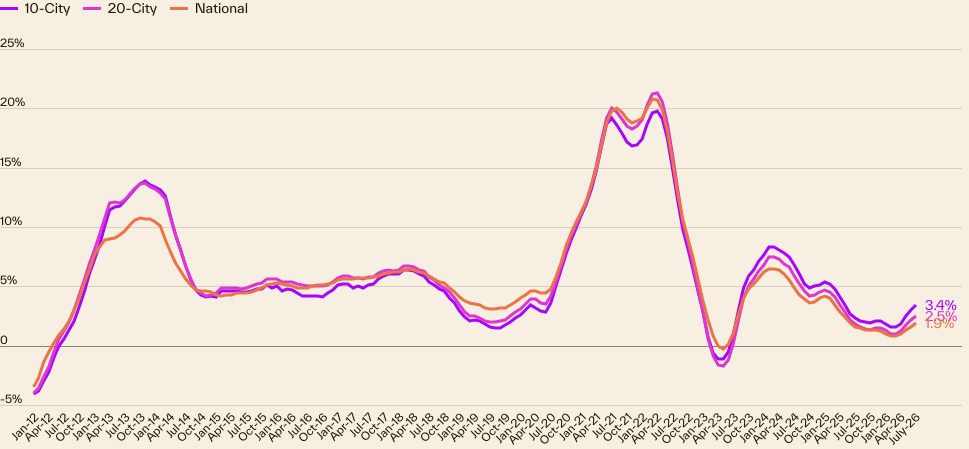
    According to a new Redfin analysis, the average homebuyer’s down payment is down from last year, falling to $64,000 in March 2026, down 1.5% year-over-year. The average down payment was 15%, down from 16.1% in 2025.

    Down payment percentages were highest in three California metros: San Jose, San Francisco and Anaheim, all at 25% each.

    Down payments were lowest in Virginia Beach at 2% and Detroit at 5%, which are both considered affordable markets.

    The data in the report is from an analysis of county records across 40 of the most populous U.S. metropolitan areas. March 2026 is the most recent month for which data is available.

    Read Full Article


  • Price drops become less common as market stabilizes

    Price drops become less common as market stabilizes

    According to a new analysis from Redfin, price cuts were slightly less common in April 2026, as the housing market showed signs of stabilization and rising homebuyer demand. More than 35.4% of U.S. home sellers cut their asking price in April 2026, down slightly from 35.6% a month earlier on a seasonally adjusted basis. This is significantly down from a record high of 36.6% in August 2025.

    The decreasing commonality of price cuts is helping sellers regain some negotiating power. Buyers are slowly returning as the job market improves, becoming a bit more confident in their earnings. While buyers are still outnumbered by sellers, they are slightly less so than before, indicating a shift towards a balanced housing market.

    Read Full Article

  • Mortgage rates average 6.51%

    Mortgage rates average 6.51%

    On May 21, 2026, Freddie Mac released the results of its Primary Mortgage Market Survey, showing the 30-year fixed-rate mortgage (FRM) averaged 6.51%. This is up from last week, when it averaged 6.36%. In May 2025, the 30-year FRM averaged 6.86%.

    “The 30-year fixed-rate mortgage averaged 6.51% this week,” said Sam Khater, Freddie Mac’s Chief Economist. “As rates fluctuate, aspiring buyers should remember that by shopping around for the best mortgage rate and getting multiple quotes, they can potentially save thousands.”

    The 15-year FRM averaged 5.85%, up from last week when it averaged 5.71%. A year ago at this time, the 15-year FRM averaged 6.01%.

    Read More

  • Brookfield receives approval for 12,000 homes on retired California Navy base

    Brookfield receives approval for 12,000 homes on retired California Navy base

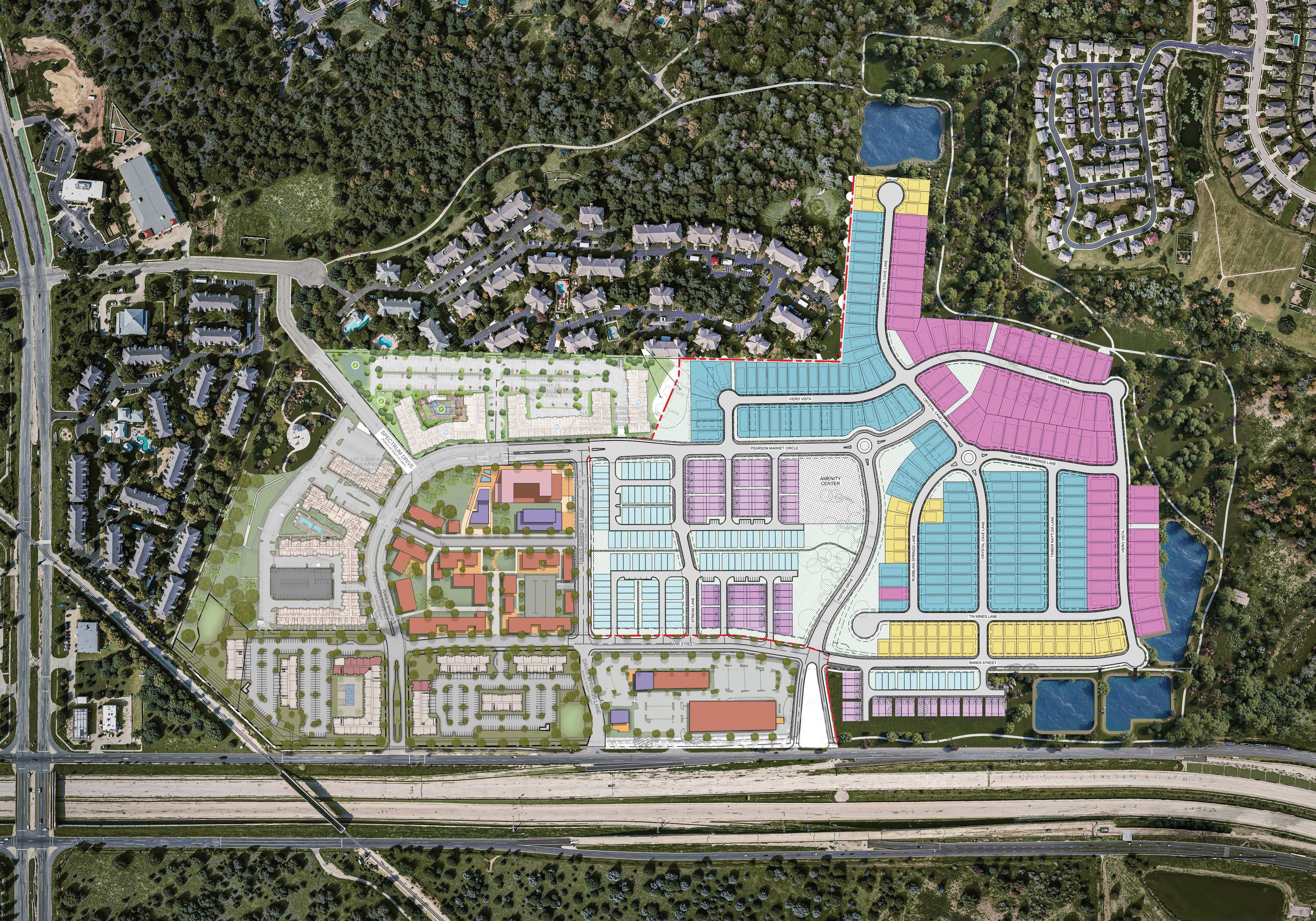
    Brookfield Residential just received unanimous approval from the Concord City Council to redevelop the Concord Naval Weapons Station in Northern California. Brookfield’s master-planned community is expected to revitalize the San Francisco Bay Area with the proposed development of 12,000 new homes, businesses, schools, fire stations and around 800 acres of dedicated parks.

    Estimations are putting the cost of the project at $7 billion, with $628 million directly to the Navy.

    For over two decades projects to transform the site were sidelined. For example, in 2016, Lennar was chosen as the developer for the site before parting ways in 2020.

    Immediate cleanup of the site is the priority, with construction slated to begin in 2030. Brookfield Residential currently has two active communities in Northern California, Amoruso Ranch and Riversound. 

    “And for the first time, we have an agreement between the city, our master developer, and the Navy, over how much we’re going to pay the Navy for the 2,400 acres we’re going to develop on the former Concord Naval Weapons Station,” said base reuse director Guy Bjerke.

    Read More 


  • Construction sees life in custom homebuilding

    Construction sees life in custom homebuilding

    The custom home market is not as heavily impacted by the interest rate cycle in comparison to other forms of homebuilding, making it a relative bright spot in residential construction. While overall single-family construction has been down 5% for the first four months of 2026, custom homebuilding is providing relief in the homebuilding.

    According to the National Association of Home Builders’ (NAHB) analysis of Census data from the Quarterly Starts and Completions by Purpose and Design survey, there were 36,000 total custom building starts during the first quarter of 2026. This is up 3% relative to the first quarter of 2025.

    Currently, the market share of custom builds, based on a one-year moving average, is 20% of total single-family starts.

    Read More

  • NAHB strives to tackle workforce gaps in housing

    NAHB strives to tackle workforce gaps in housing

    The National Association of Home Builders’ (NAHB) state and local teams met with mayors, city leaders, planners and builders to address workforce development challenges as part of the America’s Housing Comeback discussion series spearheaded by the National League of Cities and the American Planning Association. The discussion allowed city leaders to hear directly from builders about the mounting challenges they face with recruitment and retention, not only for trades professionals but also for public sector staffing.

    Ed Brady, CEO of the Home Builders Institute (HBI), and Emily Price, HBI senior vice president of development and partnership engagement, outlined how HBI programming strengthens city workforces.

    Danushka Nanayakkara-Skillington, NAHB associate vice president of forecasting and analysis, reinforced the message by providing data and insights on how labor market conditions and demographic trends affect housing development.

    Read More

  • 10 cities lead new home construction

    10 cities lead new home construction

    Consumer Affairs analyzed data on new building permits and new-construction home sales across the 150 largest U.S. metros in early 2026.  The data ranked areas based on both the number of new-build permits issued and the number of new homes sold, with each factor weighted equally. Based on the analysis, 10 cities are leading the charge in new home construction, with thousands of new housing permits issued and more than 15,000 newly constructed homes sold.

    Four of the top cities in new home construction were in Texas, with Dallas holding the leading spot. The city had 11,327 new building permits issued and over 3,000 new construction homes sold.

    Houston follows closely behind in second place, followed by New York, Phoenix, Atlanta and Los Angeles, respectively. Austin, Texas, ranked No. 7, followed by Washington, D.C., Charlotte, N.C. and San Antonio.

    Read More

  • Housing affordability increases in Q1 2026

    Housing affordability increases in Q1 2026

    Housing affordability conditions for first-time and entry-level buyers are improving at a reasonable pace. According to the National Association of Home Builders’ (NAHB) Wells Fargo Cost of Housing Index (CHI), in Q1 of 2026 the income share needed to buy a new home dropped 4% from Q2 2025.

    Despite mortgage rate changes and overall economic uncertainty, this exhibits promising signs for housing affordability for everyday Americans. The trend continues to existing homes, where income share needed to purchase dropped from 37% in Q2 2025 to 32% in Q1 2026.

    “The U.S. data for the percentage of earnings needed to purchase a new home in the first quarter is based on a national median new home price of $403,200 and median income of $106,800, said Rose Quint, assistant vice president for survey research at NAHB. “The first quarter median new home price is down slightly from $405,300 in the fourth quarter of 2025.”

    Read More 

  • HUD releases report on best homebuilding practices

    HUD releases report on best homebuilding practices

    The Department of Housing and Urban Development (HUD) released the State and Local Best Practices for Home Construction Report, a series of regulatory actions for state and local governments to increase efficiency and ease regulatory barriers to housing construction and affordability. The report provides a clear starting point for all state and local governments to begin or continue an active effort to remove unnecessary burdens to home construction. Best practices are sorted into three categories: Cut Home Construction Costs, Unlock Land for New Housing Supply and Accelerate Construction Timelines.

    “HUD is encouraging our state and local partners to take inventory of their regulations and policies and make changes that will lower the cost to build and enable more efficient housing supply growth,” said HUD Secretary Scott Turner. “These best practices are an initial list of recommendations to facilitate growth while respecting communities’ unique needs. Adding efficiency to local building processes will result in more affordable homeownership opportunities for all Americans.”

    Read More

  • Builder sentiment reports steady increase in May

    Builder sentiment reports steady increase in May

    The National Association of Home Builders’ (NAHB) Wells Fargo Housing Market Index (HMI) of Builder sentiment reported a modest gain in May, bouncing back after April’s decrease. The HMI posted a 37 for newly built single-family homes.

    NAHB cites the 21st Century ROAD to Housing Act could settle builders’ concerns while increasing housing supply.

    “The housing market remains soft as higher mortgage rates, rising gas prices and economic uncertainty related to the war in Iran continue to dampen buyer demand,” said NAHB Chairman Bill Owens. “However, efforts in the House to modify the 21st Century ROAD to Housing Act could increase the nation’s housing supply and help ease builder concerns.”

    Regionally, the Builder sentiment in Midwest registered a slight, one-point gain to 43 and the Northeast followed with a one point increase to 42. The South reported no change at 35, while the West dipped one point to 28.

    “Recent increases for long-term interest rates will continue to hold back home buyer demand,” said NAHB Chief Economist Robert Dietz. “Although some regional markets, including parts of the Midwest, are showing relative strength, the housing market continues to face significant affordability challenges.”

    Read More