
Colin Wright founded Cole West in 2016 after a successful career across large residential development companies in the state. He was heavily influenced by his father, Gary Wright, a prominent developer in Utah and applied generational career lessons to his business. After 10 years of growth, Cole West remains privately owned and operated in Centerville, Utah. The company focuses on both ground-up development and strategic acquisitions.
Mid-Year Update
Bryce Willardson, Vice President of Construction, Cole West, noted the building industry in Utah is seeing more support from its local and state governments to improve housing affordability by addressing the shortage of units. The increase in permit approvals aids responsible community growth in line with market demand.
“We’re really watching three main things right now: interest rates, growth along the Wasatch Front and how quickly resale inventory is building,” said Willardson. “Utah still has strong long-term growth because of steady job creation and people continuing to move here, but affordability is a much bigger obstacle than it was a couple of years ago.”
Despite this obstacle, there still is great demand for move-up and luxury living. Willardson noted that for his clients, lifestyle is at the forefront of the planning process.
Serene at SAGE
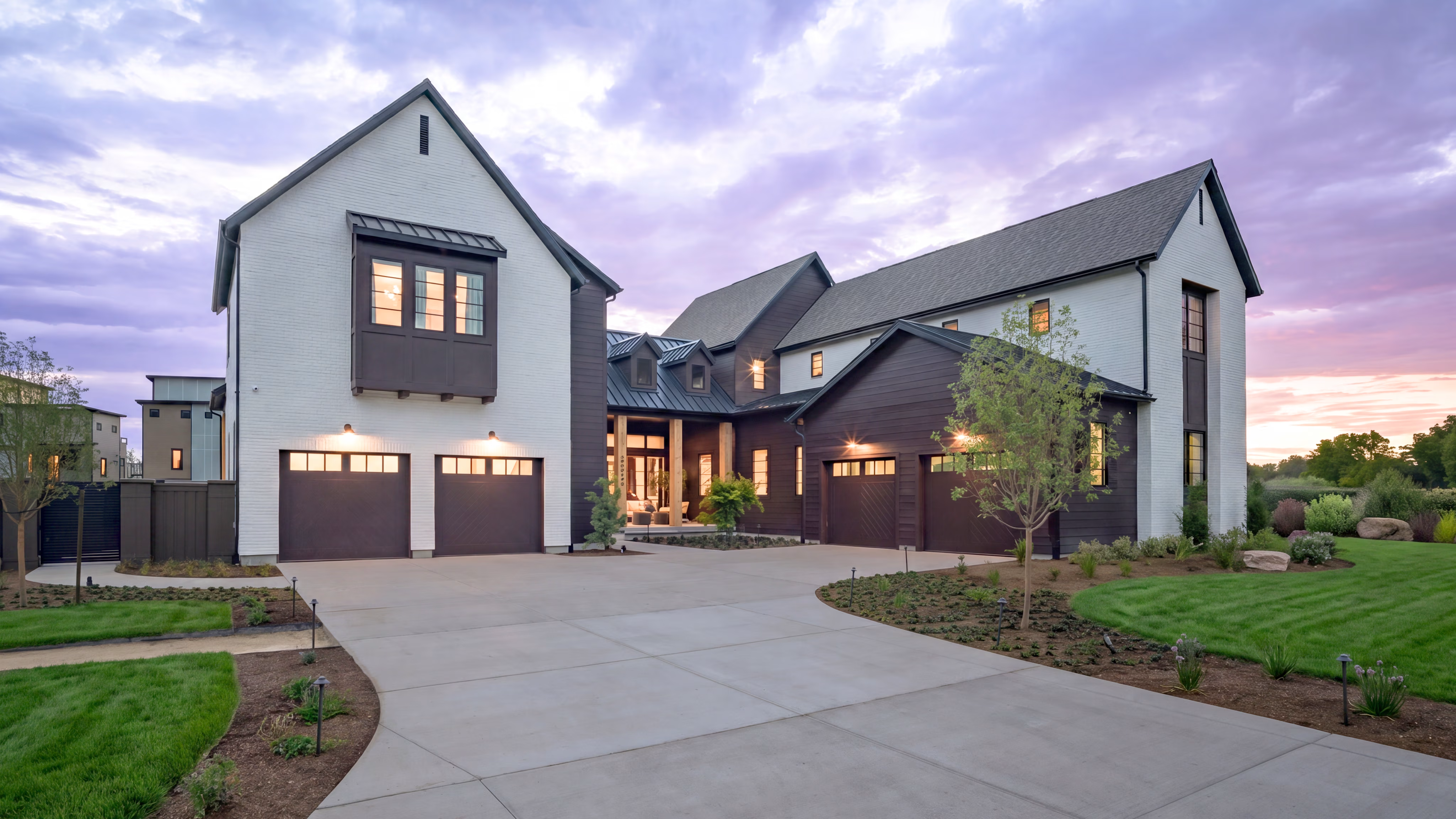
Cole West’s latest development, SAGE, is a boutique estate community in Huntsville, Utah.
Lot 3 at SAGE is 4,403 square feet and includes four-bedrooms, five-and-a-half-bathrooms, a bunk room and a four-car garage. It sits on just over three acres with sweeping views of the Wasatch Mountains. The location was central to the development, with the intentional choice to position each home with as many views as possible of the surrounding peaks and landscape while minimizing the interaction between homes.
“From my perspective, luxury today is less about excess and more about intentional living and design,” said Willardson. “In Utah’s market especially, authenticity, craftsmanship and lifestyle-driven design define true luxury.”
The facade represents a blend between transitional and farmhouse styles, using a complementary combination of stone, board and batten siding that dually blends into the rustic landscape while delivering on curb appeal. Throughout the home, Cole West capitalizes on these surroundings with large windows providing an abundance of natural light. The home comes pre-wired for motorized blinds, offering ease of upgrade. In the kitchen, custom cabinetry and large kitchen islands are paired with quartz and granite countertops, a cozy yet functional design decision. Attached to the kitchen layout is a dedicated breakfast nook with built-in convenience and more mountain views. The bathrooms charm with elevated Brizo faucets and a soaking tub. Additionally, pre-wired speaker connection delivers a whole-audio experience throughout the living room, kitchen and master bath. One of the most unique features of the home is the dedicated hot tub disconnect, installed for an easy future addition.
Behind the Beauty
While the location was central to development and offered access to nature and small-town charm, the high water table on-site was the most challenging construction headwind. To resolve this, each home was constructed using a slab on grade foundation, reducing the risk of water intrusion while eliminating the option of a basement. Additionally, beneath each slab, a gravel bed was installed to serve as a passive drainage reservoir. The reservoir allows for water to naturally flow through the gravel and out a sump-pump-equipped pipe. This forward-thinking engineering allows residents to easily resolve water removal if needed. The home also features a dual-fuel hybrid heat pump system, running on both electrical and a gas backup. This technology is in tune with the integrated smart thermostats to monitor energy usage and tankless water heaters. Cole West also roughed in an EV charger in every garage, so when homeowners are ready to go electric, the infrastructure is already there.
Looking Ahead
In the near future, Willardson anticipates the rise of AI in the architecture and design community to increase productivity and decrease the timeframe from conception to permit. In his daily construction duties, AI is integrated into scheduling between general contractor and subcontractors. He also believes the ability to process shop drawings, product data submittals, detect plan deficiencies and process payments will all continue to gain with the use of this technology.
“Over the next decade, the developers who succeed will be the ones who can combine technology with practical housing solutions that align with how people actually want to live,” said Willardson.
Photo Credit: Camelot Homes
By Sofia Feeney. She is the Editor at Builder and Developer and can be reached at sofia@builder.media.
This story is also featured in B&D June, read the print version.