

virtual conference

  • Rugged Wild Meets Refined Luxe

    Rugged Wild Meets Refined Luxe

    Colin Wright founded Cole West in 2016 after a successful career across large residential development companies in the state. He was heavily influenced by his father, Gary Wright, a prominent developer in Utah and applied generational career lessons to his business. After 10 years of growth, Cole West remains privately owned and operated in Centerville, Utah. The company focuses on both ground-up development and strategic acquisitions.

    Mid-Year Update 

    Bryce Willardson, Vice President of Construction, Cole West, noted the building industry in Utah is seeing more support from its local and state governments to improve housing affordability by addressing the shortage of units. The increase in permit approvals aids responsible community growth in line with market demand. 

    “We’re really watching three main things right now: interest rates, growth along the Wasatch Front and how quickly resale inventory is building,” said Willardson. “Utah still has strong long-term growth because of steady job creation and people continuing to move here, but affordability is a much bigger obstacle than it was a couple of years ago.” 

    Despite this obstacle, there still is great demand for move-up and luxury living. Willardson noted that for his clients, lifestyle is at the forefront of the planning process. 

    Serene at SAGE

    Cole West’s latest development, SAGE, is a boutique estate community in Huntsville, Utah. 

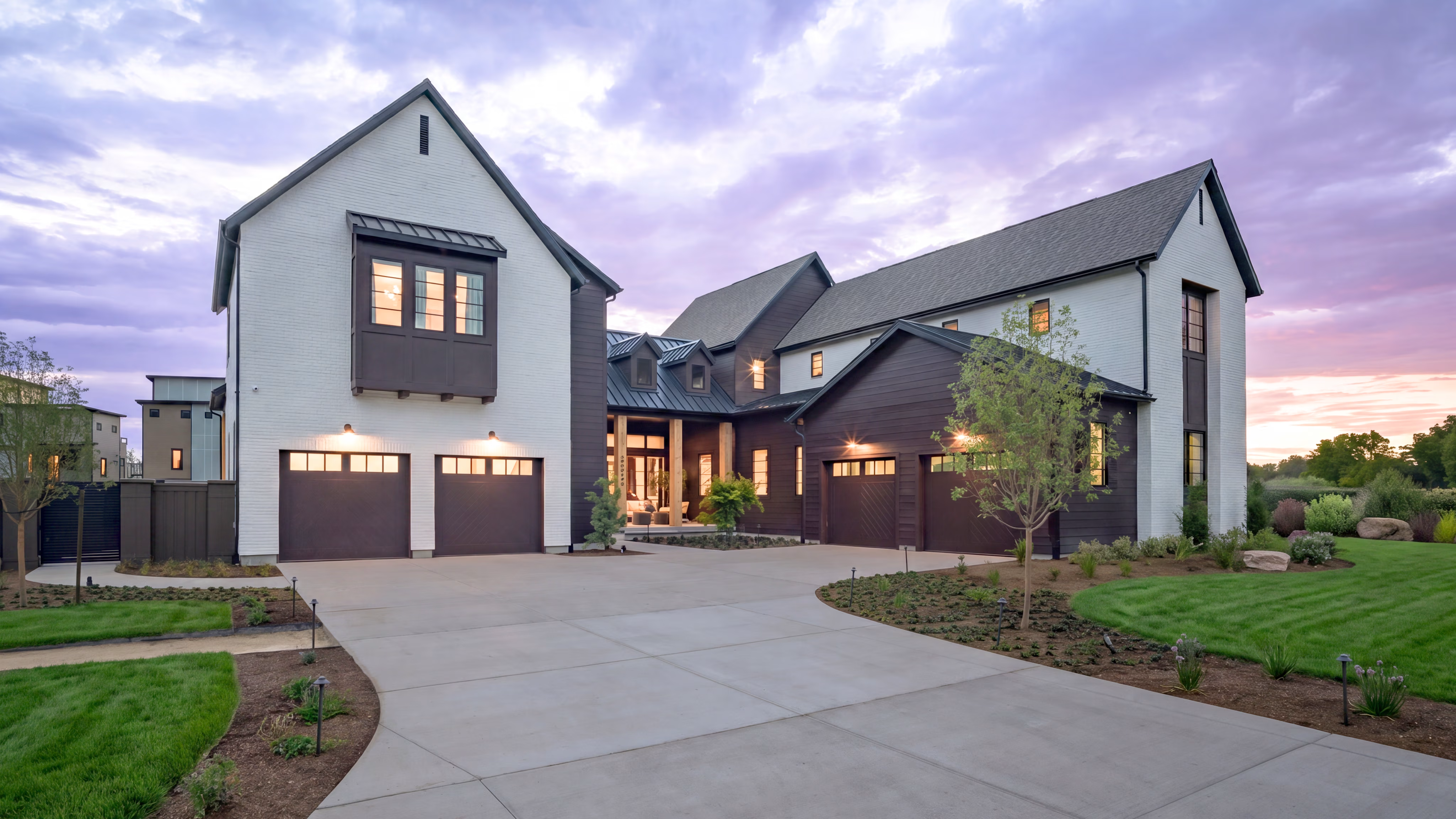
    Lot 3 at SAGE is 4,403 square feet and includes four-bedrooms, five-and-a-half-bathrooms, a bunk room and a four-car garage. It sits on just over three acres with sweeping views of the Wasatch Mountains. The location was central to the development, with the intentional choice to position each home with as many views as possible of the surrounding peaks and landscape while minimizing the interaction between homes. 

    “From my perspective, luxury today is less about excess and more about intentional living and design,” said Willardson. “In Utah’s market especially, authenticity, craftsmanship and lifestyle-driven design define true luxury.”

    The facade represents a blend between transitional and farmhouse styles, using a complementary combination of stone, board and batten siding that dually blends into the rustic landscape while delivering on curb appeal.  Throughout the home, Cole West capitalizes on these surroundings with large windows providing an abundance of natural light. The home comes pre-wired for motorized blinds, offering ease of upgrade. In the kitchen, custom cabinetry and large kitchen islands are paired with quartz and granite countertops, a cozy yet functional design decision. Attached to the kitchen layout is a dedicated breakfast nook with built-in convenience and more mountain views. The bathrooms charm with elevated Brizo faucets and a soaking tub. Additionally, pre-wired speaker connection delivers a whole-audio experience throughout the living room, kitchen and master bath. One of the most unique features of the home is the dedicated hot tub disconnect, installed for an easy future addition. 

    Behind the Beauty  

    While the location was central to development and offered access to nature and small-town charm, the high water table on-site was the most challenging construction headwind. To resolve this, each home was constructed using a slab on grade foundation, reducing the risk of water intrusion while eliminating the option of a basement. Additionally, beneath each slab, a gravel bed was installed to serve as a passive drainage reservoir. The reservoir allows for water to naturally flow through the gravel and out a sump-pump-equipped pipe. This forward-thinking engineering allows residents to easily resolve water removal if needed.  The home also features a dual-fuel hybrid heat pump system, running on both electrical and a gas backup. This technology is in tune with the integrated smart thermostats to monitor energy usage and tankless water heaters. Cole West also roughed in an EV charger in every garage, so when homeowners are ready to go electric, the infrastructure is already there.

    Looking Ahead

    In the near future, Willardson anticipates the rise of AI in the architecture and design community to increase productivity and decrease the timeframe from conception to permit. In his daily construction duties, AI is integrated into scheduling between general contractor and subcontractors. He also believes the ability to process shop drawings, product data submittals, detect plan deficiencies and process payments will all continue to gain with the use of this technology.

    “Over the next decade, the developers who succeed will be the ones who can combine technology with practical housing solutions that align with how people actually want to live,” said Willardson.

    Photo Credit: Camelot Homes

    By Sofia Feeney. She is the Editor at Builder and Developer and can be reached at sofia@builder.media

    This story is also featured in B&D June, read the print version.

  • Post-Powell Era: A Housing Market Rebound

    Post-Powell Era: A Housing Market Rebound

    Jerome Powell’s term as Fed Chairman is over and now begins the inevitable process of assessing his time in power with the benefit of hindsight. I believe history will eventually show his tenure to have been marked by enormous mistakes that continue to distort the U.S. economy; particularly in housing where we may well remember Powell as the Fed Chairman who froze the American market.

    Over the last year, U.S. housing markets have seen two positive developments: inventories of existing homes for sale have returned to pre-pandemic levels and mortgage rates have drifted down from the 7% range to the low 6’s. Combined with a homeowner vacancy rate of just 1.1% lower than at any point from 1980 to 2020 and home prices growing more slowly than household incomes, we should be seeing signs of recovery in home sales.

    Instead, existing home sales remain below even the worst years of the Great Recession housing collapse. Inventories of new homes for sale are stuck at roughly nine months of supply, near record highs. Housing starts and homeownership rates are drifting downward, even as frustration among would-be buyers grows.

    Politicians call this an affordability crisis, but that misses the point. Existing homeowners are not struggling with affordability. Housing equity is at record highs, roughly $400,000 per homeowner and owner costs as a share of income remain historically modest at 18.9% in 2024, below levels seen from 2005 to 2015. Renters are not dramatically worse off either, with median rent-to-income ratios at 32%, well within the range of the last 25 years.

    The real problem is market paralysis. Most homeowners are sitting on mortgages far below current borrowing rates. According to the Federal Housing Finance Agency, four out of five mortgage holders have rates below 6% and two-thirds are below 5%. Moving to a similarly priced home would mean sharply higher monthly payments, giving owners little reason to sell unless absolutely necessary. 

    The result is a collapse in what economists call filtering. Entry-level homes are no longer becoming available because existing owners are not moving up. 

    Builders, facing high fixed construction costs, avoid lower-margin starter homes altogether. The market is trapped in a vicious cycle: too little movement, too little supply where it is needed and prices that stay elevated because turnover remains frozen.

    This mess is the direct consequence of the Fed’s extreme pandemic-era policies. Roughly $5 trillion in quantitative easing, far beyond anything the economy needed to deal with the short shock created by the pandemic, pushed mortgage rates into the mid-2’s even as home prices surged. Then the inevitable inflation caused by expanding the money supply by 40% in 18 months forced the Fed to reverse course at breakneck speed, hiking rates aggressively. Mortgage rates shot into the 7’s and the housing market seized up.

    Policymakers need to focus on breaking this logjam. One obvious solution would be to make mortgages assumable again, as many VA and Federal Housing Administration loans once were, allowing owners to move without losing low-rate financing. Another would be to reduce the fixed costs of building entry-level housing such as townhomes.

    Instead, politicians continue chasing headline-friendly but ineffective policies such as the 21st Century ROAD to Housing Act (H.R. 6644), which seeks to ban large investors from owning single-family rental homes, removing yet another potential source of housing supply. 

    These policy choices shouldn’t be that surprising. After all, Powell leaves his post still insisting that the Fed actions of 2020 and 2021 had nothing to do with the subsequent increase in prices. Inflation, failed banks, asset bubbles and a frozen housing market that could be with us for a long time to come. This is Jerome Powell’s real legacy and one we’ll continue to grapple with in the coming years. 

    By Christopher Thornberg, PhD. He is Founding Partner of Beacon Economics LLC. He can be reached at chris@beaconecon.com.

    This column is featured in our June issue of Builder and Developer. Read the print version

  • Designing For Today’s Luxury Homebuyer

    Designing For Today’s Luxury Homebuyer

    This issue of Builder and Developer features our mid-year housing update and insights into the future of luxury living.

  • Construction employment increases in 32 states

    Construction employment increases in 32 states

    Construction employment rose in 32 states from April 2025 to April 2026, according to an analysis of new federal data released by the Associated General Contractors of America (AGC)on May 22, 2026. Texas added the most construction jobs, adding approximately 18,700 jobs, followed by North Carolina, Ohio, Louisiana, Illinois and Missouri. Louisiana had the largest percentage gain in the span of 12 months.

    “It’s encouraging to see construction employment increasing in many parts of the country,” said Ken Simonson, the AGC’s chief economist.

    In April 2026, Florida added the most construction jobs with 6,000, followed by Texas with 3,500, Massachusetts with 3,100, North Carolina with 2,700 and New Mexico with 2,600.

    Read More

  • The Housing Outlook for late 2026

    The Housing Outlook for late 2026

    The housing market in the first half of 2026 was largely characterized by stabilization, ongoing affordability constraints and muted transaction…

    by

    Read Full Article →

  • Rugged Wild Meets Refined Luxe

    Rugged Wild Meets Refined Luxe

    Colin Wright founded Cole West in 2016 after a successful career across large residential development companies in the state. He…

    by

    Read Full Article →